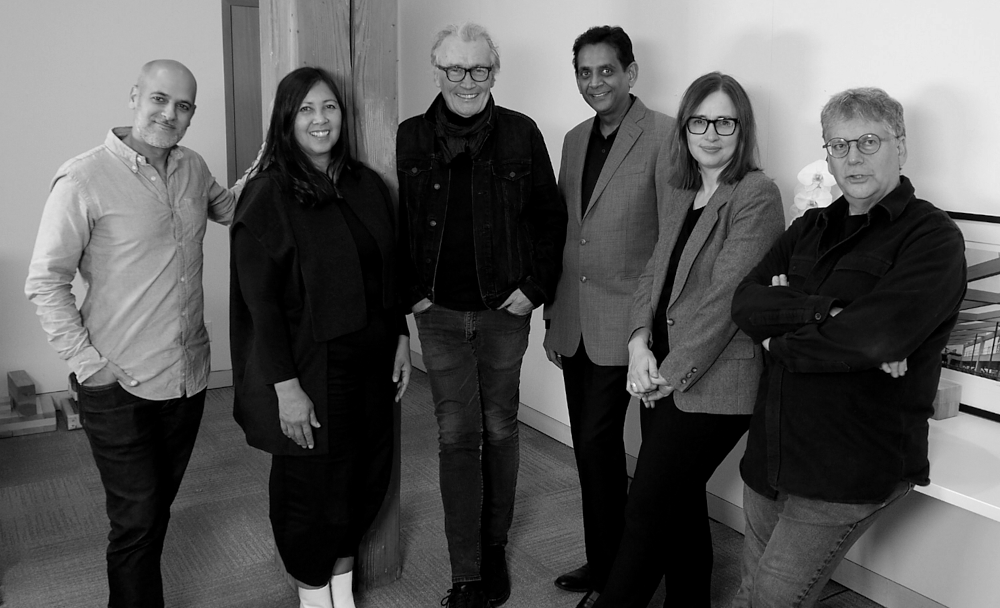
Moriyama and Teshima Architects, past, present and future.
Starting far left, Ronen Bauer, Carol Phillips, Diarmuid Nash, Urvish Patel, Emmanuelle van Rutten, and Brian Rudy
 Above, one of six totems designed and built by Raymond Moriyama
Among most anticipated interviews is with senior partner, Diarmuid Nash, who worked there and collaborated with Moriyama the longest. Nash has the experience and stories that are valued such as when the firm made (and lost) the bid for the Ontario Science Centre renovation during the 1990’s. Nash also worked on several more projects alongside Moriyama due to his tenure.
Moriyama and Teshima have accomplished many interesting projects, but nothing on the vast scale like the Ontario Science Centre (OSC) that launched the firm in the first place, from more modest boutique designs to large scale government contracts. Government investment in education and infrastructure is not what it used to be, so architecture firms are challenged with material and budget constraints. There is obvious excitement, however, with the staff when they discuss projects that facilitate environmental and technological innovation in building and design, such as using repurposed materials or breathing new life in older buildings. The firm are still involved in some of Canada’s most important buildings, but the country is not what it used to be. Moriyama & Teshima is no longer bound by national architecture constraints as they now have a growing and thriving portfolio of international projects.